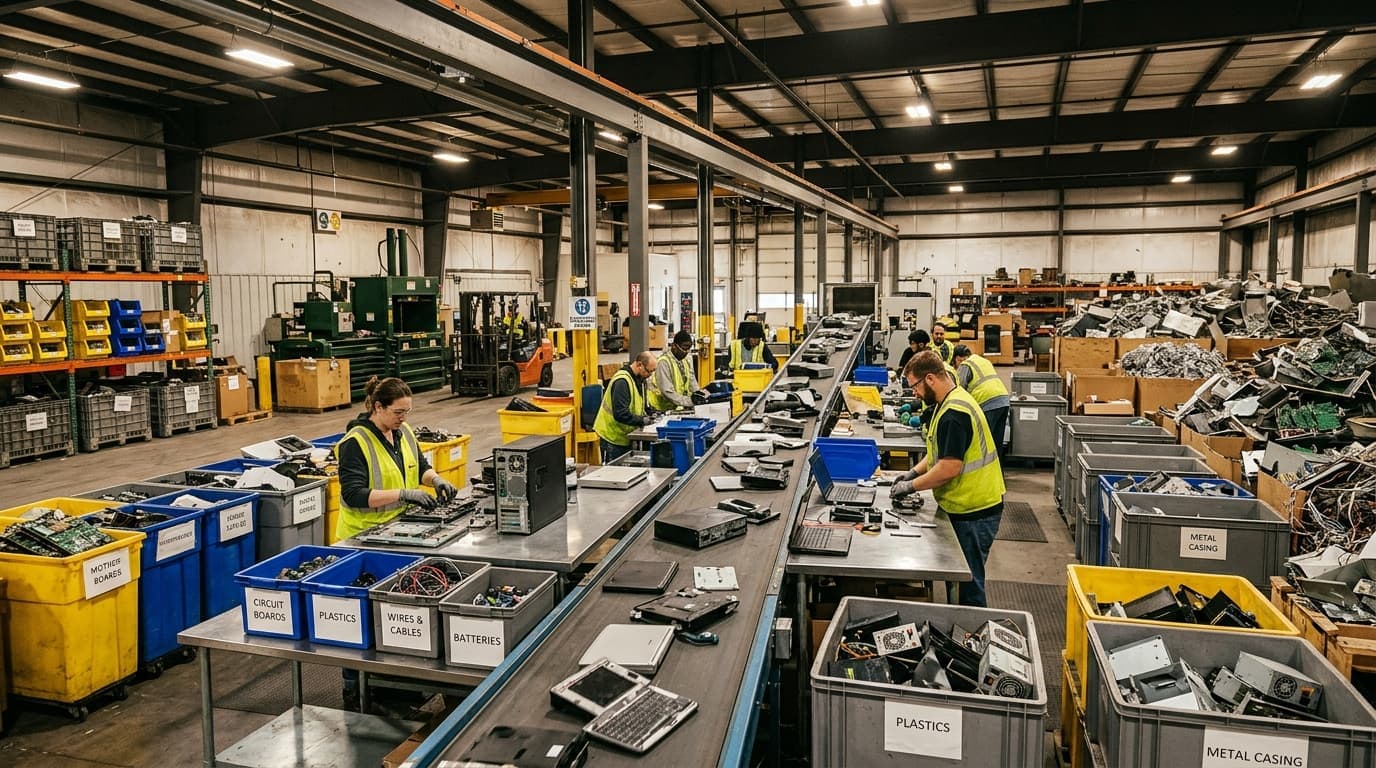
The short answer. A Georgia business disposes of old network equipment by wiping each device's configuration, recording the serial numbers, and sending the hardware to a recycler that documents the collection and recovers the metals. American Resources picks up switches, routers, firewalls, access points and the racks and cabling around them from businesses across metro Atlanta.
Network gear does not look like a data device, which is why it is the equipment most often carried out of a building with the data still on it. A switch or router holds its configuration in flash: interface addresses, VLANs, routing tables, admin passwords, VPN pre-shared keys, certificates, SNMP community strings, and often a log of who connected. A firewall holds the shape of your whole security boundary. NIST's media sanitization guide names "mobile computing devices, networking devices, and office equipment" alongside computers as devices with storage that has to be sanitized before disposal.
#Step one: erase the configuration
Before a device is unracked, an administrator restores it to factory defaults through the vendor's documented procedure, then confirms on the console that the startup configuration is gone and that no backup configuration or license file remains in flash. Where the device has a removable storage card, pull it. Where a device is dead and cannot be reset, treat its flash as a hard drive: it goes to physical destruction and onto the certificate.
Two things people forget. Access points often hold the wireless passphrase and the controller address. Modular chassis hold configuration on the supervisor card, and sometimes on each line card. Reset the parts, not the box.
#Step two: record what is leaving
Export the inventory from your network management system, or walk the rack with a label scanner: model, serial number, asset tag, location. That list becomes the manifest the recycler signs against, and it is the document your auditor, your cyber-insurer and your own change log will want. The recycler's manifest and yours should match line for line; the chain of custody guide explains what each record proves.
#Step three: separate value from scrap
Enterprise switches, routers and firewalls under about five years old, still supported by the vendor, often carry resale value on the secondary market. Older or unsupported units are recycled for their boards, copper and steel. A recycler that does both will tell you which units are which from the model list, before pickup, so the quote reflects it. Optics, power supplies and fan trays travel with the chassis.
#Racks, cabling and power
A network cleanout usually comes with the rack itself, patch panels, cable management, PDUs and hundreds of feet of copper and fiber. All of it is recyclable and none of it holds data. Coil and bundle cable if you can; it speeds the load. PDUs and uninterruptible power supplies contain batteries that follow their own rules, covered in the UPS battery guide.
#What Georgia adds
No state law names network equipment. Georgia's hazardous waste rules adopt the federal rules by reference, and the federal obligations that reach network gear are the ones attached to the data it protected: customer information at a financial institution, consumer report information, protected health information at a practice. The rules and their wording are in the Georgia e-waste regulations guide.
Decommissioning a closet, a rack or a whole room? Request a server room decommissioning quote or send the model list through the contact form.